

Reconceptualizing Healing in Psychedelic Care Through a Nursing Lens
Authors: Madison Nobbs, RN, BScN, Zoe Spyralatos, DNP, PMHNP-BC, JoEllen Schimmels, PhD, DNP, RN, PMHNP-BC, CNE, FAAN
Corresponding Author: JoEllen Schimmels; email: joellen.schimmels@emory.edu
Abstract
As engagement in psychedelic-assisted care accelerates ahead of clear regulatory standards, nursing is positioned at a significant point in clinical practice and professional development. This paper examines psychedelic-assisted care through a nursing lens by considering its alignment with established nursing theories, drawing on the frameworks of Hildegard Peplau’s Interpersonal Relations Theory and Jean Watson’s Theory of Human Caring. Integrating nursing theory with empirical evidence and clinical practice, we identify gaps in standardized training, role clarity, and nursing leadership in the psychedelic space. The safe, equitable, and scalable integration of psychedelic care will require specialty recognition, competency-based education, and defined certification pathways within nursing.
Introduction
Psychedelic substances have been used for centuries, but modern research and clinical interest have grown rapidly in recent decades (Nutt & Moss, 2024). Psychedelic substances such as ketamine and psilocybin induce altered states of consciousness that may promote insight, emotional processing, and psychological healing (Van Derveer & Kurlander, 2026). A recent RAND (Priest et al., 2026) report was one of the first nationally representative looks at the sizable population-level behavior in the use of psychedelics in the U.S. In healthcare, specifically nursing, this surge creates both an opportunity and a gap, as education, clinical guidelines, and theoretical frameworks have not kept pace with increasing patient and clinician interest (Eshkevari et al., 2026; Penn et al., 2021a).
Collectively, nursing involvement in psychedelic care spans a continuum of roles, ranging from advanced practice nurses, such as psychiatric-mental health nurse practitioners and clinical nurse specialists, who may provide psychedelic-assisted psychotherapy, to registered nurses, nurse practitioners, and clinical nurse specialists who participate in screening, preparation, medication administration, monitoring, and integration support. As a result, nurses may be unprepared to address patient questions or apply emerging evidence effectively. However, nurses are well positioned to engage and participate in psychedelic therapies. As psychedelic therapies become more mainstream, nursing curricula will need to be adapted giving nurses an opportunity to practice psychedelic care as advocates, leaders, innovators, researchers, practitioners, and educators (Denis-Lalonde & Estefan, 2020).
Psychedelic-assisted care shows promise for treating mental health disorders, substance use, existential distress, and other chronic conditions (Nutt & Moss, 2024; Van Derveer & Kurlander, 2026). Their effects may stem from both the subjective psychedelic experience and underlying neuroplastic changes that can potentially reset rigid patterns of thinking, but medicine
alone is not responsible for the changes seen in patients. These treatments often emphasize insight, emotional processing, and personal transformation rather than just symptom reduction (Olson, 2018; Zhang et al., 2026) with the role of nurses and other clinicians crucial for positive patient outcomes (Kishon et al., 2024). In therapeutic psychedelic settings, considerable attention is also given to creating safety and support conducive to healing. A common phrase in psychedelic care is that of
set and setting meaning the mindset and psychological preparation of the patient as well as the environment in which the medicine experience occurs can profoundly influence clinical outcomes as well as the subjective experience of patients and clinicians ( World Health Organization, 1958).
This shift beyond symptom reduction challenges traditional biomedical models and aligns more closely with nursing’s holistic focus on meaning, relationships, and patient experience. However, nursing has yet to fully define its role in this space. In fact, nursing interest in psychedelics exceeds their competence as many nurses are curious but underprepared in this space (Porta et al., 2024). This article argues for developing a stronger theoretical foundation, drawing on frameworks of Hildegard Peplau and Jean Watson, to guide ethical, relational, and clinically sound integration of psychedelic-assisted care within nursing practice.
Nursing Framework for Psychedelic Care
In their influential work, Penn et al. (2021a) applied Jean Watson’s Human Caring Science to psychedelic-assisted therapy, positioning Watson’s caring processes as a framework for psychedelic therapy. Building on this foundation, Peplau’s Interpersonal Relations Theory and Watson’s Theory of Human Caring together provide a complementary framework for understanding any nursing’s role within psychedelic-assisted care, as illustrated in Figure 1 (Peplau, 1962; Watson, 2008). The nurse-patient relationship in psychedelic care is dynamic, evolving, and meaning-making. Peplau’s theory emphasizes the therapeutic use of this relationship as a vehicle for growth, positioning the nurse as an active participant in phases of orientation, working, and resolution, processes that closely parallel preparation, dosing, and integration in psychedelic therapy. Each phase reconfigures the patient’s internal experience while the nurse helps maintain coherence, safety, and direction. Peplau’s theory emphasizes the therapeutic use of the nurse–patient relationship as a vehicle for growth, positioning the nurse as an active participant in phases of orientation, working, and resolution; processes that closely parallel preparation, dosing, and integration in psychedelic therapy.
Figure 1. Peplau and Watson Nursing Models Across Psychedelic Phases
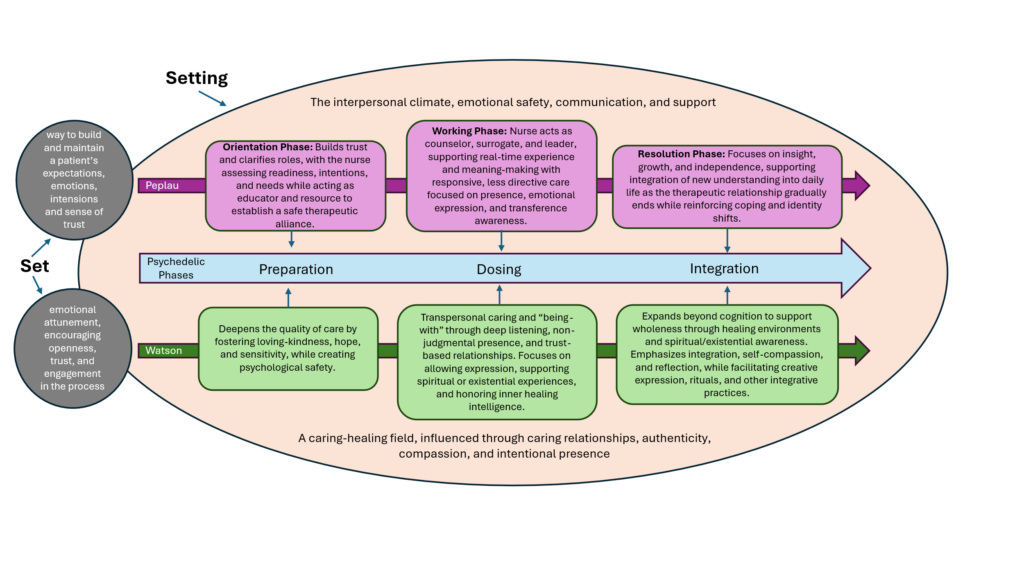
Within psychedelic contexts, nurses can draw on Peplau to structure therapeutic engagement and communication, while Watson informs the quality of presence, compassion, and holistic support offered throughout the experience. Together, these theories reinforce that effective psychedelic nursing care extends beyond pharmacologic management to include intentional relationship-building, emotional attunement, environmental stewardship, and support for meaning-making, all of which are critical to safe, ethical, and therapeutic outcomes. Through Peplau’s Interpersonal Relations Theory, set is co-constructed within the nurse–patient relationship. In the orientation phase, the nurse assesses anxiety, clarifies expectations, and identifies interpersonal patterns that may emerge during the psychedelic experience. The nurse functions as counselor, teacher, and resource, helping the patient recognize internal conflicts and develop psychological readiness. Here, set becomes relationally informed, shaped through dialogue, trust-building, and the patient’s evolving self-awareness.
In contrast, Watson’s theory deepens this relational focus by centering transpersonal caring, presence, and the intentional creation of a healing environment, with steady presence bringing patterns into clarity. This grounding presence is essential as patients enter vulnerable, often profound altered states of consciousness, where internal experiences continuously reorganize and take on new meaning.
Watson’s Theory of Human Caring offers a strong conceptual fit for psychedelic-assisted care (Penn et al., 2021a), as both emphasize healing through relationships, presence, and holistic engagement with human experience. The set, setting, and therapeutic relationship, aligning closely with Watson’s core principles of caring science (Watson, 2008). Her concept of transpersonal caring, connecting with patients beyond the physical to the emotional, psychological, and spiritual dimensions, parallels the depth of experiences often encountered in non-ordinary states of consciousness. In these states, patients may engage with profound insights, existential themes, or spiritual content. Nurses grounded in Watson’s theory are well positioned to hold space for these experiences without judgment, support integration and meaning making, and recognize healing as an expansive process that extends beyond symptom reduction.
From Watson’s Theory of Human Caring, the set can be understood as the energetic and intentional field of consciousness. Watson’s Caritas Processes, particularly cultivating loving-kindness, authentic presence, and transpersonal connection, invite the nurse to attend not only to what the patient thinks, but to how they are in themselves. Preparation becomes a sacred act of co-regulation and meaning alignment, where the nurse helps the patient enter the experience with openness, trust, and a sense of inner safety. The set is not fixed; it is gently shaped through presence, narrative exploration, and the creation of a caring-healing consciousness (Penn et al., 2021b).
Peplau and Watson’s emphasis on the environment aligns with the psychedelic principle of setting. Intentional design of the environment, including safety, comfort, emotional tone, can significantly influence outcomes and reduce anxiety. Both theorists also focus on therapeutic presence and alliance as a central component. This focus on the relationship between nurse and patient is crucial in focusing on the whole person and integration of mind, body and spirit.
Taken together, these frameworks suggest that psychedelic-assisted therapies do not create an entirely new role for nurses; rather, they highlight how longstanding nursing competencies, such as therapeutic presence, environmental stewardship, and facilitation of meaning-making, serve as central mechanisms of care.
System, Policy, and Regulatory Level
Federal research institutions such as the National Institutes of Health (NIH) and its constituent agencies have adopted a cautious, evidence-driven stance toward psychedelic and dissociative substances as potential medicines while supporting transdisciplinary research (NIH, 2025). The National Institute on Drug Abuse (NIDA) emphasizes that while only ketamine and its derivative esketamine are currently approved for clinical use, a broader range of psychedelics and related compounds is being studied under controlled conditions to evaluate their therapeutic relevance for mood disorders, substance use disorders, and other conditions (NIDA, 2024). At present, ketamine and its S-enantiomer esketamine (branded as Spravato®) remain the only FDA-approved agents with psychedelic-like properties for specific psychiatric indications. Other compounds, including psilocybin and MDMA, remain investigational (Cabrera Abreau, et al., 2025) although Compass Pathways, a biotechnology company that has been studying investigational psilocybin treatment in several mental health conditions reported positive results from their Phase 3 trials in February 2026 and plans to meet with the Food and Drug Administration to discuss submitting their medication, COMP360 for review with anticipated approval by December 2026 (Bell, 2026). In addition, ATAI Life Sciences has received breakthrough therapy designation in October 2025 for their product BPL-003 (Intranasal 5-MeO-DMT) for treatment-resistant depression (Roberts et al., 2026).
These substances are administered within research protocols that include medical supervision and psychotherapeutic support, underscoring that their effects are not assumed beneficial outside structured settings. NIH-supported research also investigates how these compounds alter brain networks and connectivity, findings that may elucidate mechanisms relevant to reconsolidation and other processes central to therapeutic change. At the same time, NIH acknowledges significant gaps in understanding, reflects safety concerns, and explicitly calls for more rigorous research before these interventions can be widely adopted in clinical practice.
The Veterans Affairs (VA) National Center for post-traumatic stress disorder (PTSD) (2025) outlines that psychedelic-assisted therapy, particularly with 3,4-methylenedioxy-methamphetamie (MDMA) and psilocybin, is an active area of research being examined to augment psychotherapy for PTSD, especially in individuals who do not respond sufficiently to existing treatments. The most advanced in PTSD research is MDMA-assisted therapy, with controlled trials demonstrating significant symptom reduction when MDMA is combined with structured therapy sessions involving preparation, guided administration, and integration, though it remains not yet FDA-approved for clinical use. Psilocybin assisted therapy is also being studied for its effects on neural connectivity, emotional processing, and psychological flexibility, which are considered relevant to PTSD treatment even though direct PTSD data are limited. Both MDMA and psilocybin assisted therapies emphasize the importance of set and setting as essential to safety and effectiveness. The VA notes several research challenges such as maintaining blinding in trials, limited inclusion of Veterans in existing studies, and the need for further rigorous investigation before broad implementation within VA clinical settings.
The current regulatory environment reflects both momentum and fragmentation. Over the past five years, more than 220 psychedelic-related bills have been introduced across 38 states and Washington, D.C., with only a small proportion enacted (Chapman, 2025). Most successful measures have taken the form of “starter bills,” establishing study commissions or pilot programs rather than comprehensive clinical frameworks. In the absence of broad federal reform, states have assumed a leadership role, largely in response to continued and escalating mental health, suicide, and substance use crises, a growing body of scientific evidence, and increasing grassroots demand from patients seeking alternatives to conventional treatments (Chapman, 2025). This landscape began to shift in April 2026, when the President of the United States issued the executive order Accelerating Medical Treatments for Serious Mental Illness, formally recognizing the urgent need for innovative approaches to conditions associated with high morbidity and suicide risk (The White House, 2026). The order directs agencies such as the U.S. Food and Drug Administration and the Department of Health and Human Services to prioritize promising therapies, with particular emphasis on psychedelic-assisted treatments. This represents a meaningful policy shift, reducing regulatory barriers, increasing federal investment, and maintaining safety oversight, while also advancing cross-sector collaboration by supporting earlier-stage research, establishing clearer regulatory pathways, and fostering coordination among academic institutions, private industry, and healthcare systems.
Alongside investigation of therapeutic compounds, contemporary psychedelic development increasingly includes specification of structured delivery environments and supervision requirements designed to meet regulatory expectations for safety, reproducibility, and scalability for safety (Palitsky et al., 2024). These emerging treatment pathways resemble other successful nurse-implemented and monitored outpatient medical interventions, such as neuromodulation therapies and infusion-based psychiatric treatments, rather than exclusively psychotherapy-based care models. As psychedelic therapies transition from research settings into routine clinical implementation, workforce structures capable of supporting protocolized monitoring and interdisciplinary coordination will become increasingly necessary.
Researchers emphasized the challenge of navigating increasing public, commercial, and clinical enthusiasm while resisting hype that outpaces evidence from articles that inappropriately encourage more positive appeal (Millar et al, 2020). As psychedelic research expands beyond small academic networks into more regulated and commercially influenced spaces, concerns with inconsistent training and implementation standards and inequitable access must be addressed. Early clinical trials of psychedelic-assisted therapies frequently relied on intensive therapist-led delivery models developed within research environments. However, such approaches (even if often considered necessary for best treatment outcomes) may be difficult to sustain at scale within publicly funded or insurance-based healthcare systems due to workforce limitations and cost considerations. Emerging regulatory frameworks increasingly emphasize structured supervision, standardized protocols, and medically integrated delivery pathways, suggesting that future implementation models will likely depend on interdisciplinary teams rather than psychotherapy-only structures.
Hope for the Demands of Nursing Practice
Key studies highlight the need for interventions targeting a wide range of workplace stressors experienced by nurses and negatively influencing patients (Basu et al., 2025; Li et al., 2024). Efforts to address nursing shortages, retention, and well-being have largely emphasized individual resilience rather than systemic solutions. In the context of ongoing concerns related to workforce shortages, burnout, and moral distress, opportunities to engage in meaning-centered and relationally sustained models of care may support professional retention, therapeutic optimism, and well-being while positioning nurses as leaders in the safe and ethical implementation of emerging psychedelic-assisted therapies (Dalgleish et al., 2020; Maki, 2025; Spotswood, 2024).
Nurses working in psychedelic practice may also offer professional benefits through reconnecting with core caring science traditions that emphasize presence, understanding, and holistic engagement across emotional, cognitive, somatic, and spiritual domains (Li et al., 2024; Penn et al., 2021b). Nurses have identified the authenticity of working with clients in altered states, where the focus is on core nursing values such as being present and with patients, and are hopeful and encouraged by emerging treatment approaches for patients who have found no relief with traditional treatments (Maki, 2025).
Conclusion
The safe, equitable, and adaptable integration of psychedelic care into healthcare systems will depend on deliberate advancement within the nursing profession. This includes foundational nursing frameworks, formal recognition of psychedelic care as a nursing specialty, the development of competency-based education to ensure consistent and evidence-informed practice, and the establishment of clearly defined certification pathways. Together, these elements will support role clarity, uphold standards of care, and position nurses to contribute effectively to the ethical and clinically sound implementation of psychedelic-assisted therapies.
Conflict of Interest Statement: The authors declare no conflict of interest. No funding was provided for this project.
References
Basu,D. , Akter,H. , Gharami,T. M, Bashu,T. and Hasan,M. M. (2025). Stressors in work environments and related factors among
nurses: A cross-sectional study. Journal of Nursing Advances in Clinical Sciences, 2(Issue 3), 153-159. doi: 10.32598/JNACS.2412.1122
Bell, J. (2026, February 17). Compass, with Phase 3 hits, ready to take psilocybin to the FDA. BioPharmaDive. https://www.biopharmadive.com/news/compass-trial-data-fda-application-psilocybin-psychedelics/812332/
Cabrera Abreu, C., Biorac, A., Baldessarini, R. J., & Vázquez, G. H. (2025). From model psychosis to rapid antidepressant: a historical and conceptual review of ketamine’s psychiatric history. Therapeutic Advances in Psychopharmacology, 15. doi:10.1177/20451253251392429
Chapman, S. (2025, April 8). National Psychedelic Landscape Assessment. Toolbox Strategies. https://www.cppolicy.org/s/NPLA-Report-web-11.pdf
Dalgleish T, Black M, Johnston D, Bevan A. (2020). Transdiagnostic approaches to mental health problems: Current status and future directions. J Consult Clin Psychol., 88(3), 179-195. doi: 10.1037/ccp0000482.
Denis-Lalonde, D., & Estefan, A. (2020). Emerging psychedelic-assisted therapies: Implications for nursing practice. Journal of Mental Health and Addiction Nursing, 4(1), e1–e13. https://doi.org/10.22374/jmhan.v4i1.40
Eshkevari, L., Schimmels, J., Olenick, M., Porta, C. M., Glymph, D. C., & Ramirez, J. (2026). Integrating psychedelics into nursing education and practice: Historical, clinical, and educational perspectives. The Journal for Nurse Practitioners, 22, 105833. https://doi.org/10.1016/j.nurpra.2026.105833
Kishon, R., Modlin, N. L., Cycowicz, Y. M., et al. (2024). A rapid narrative review of the clinical evolution of psychedelic treatment in clinical trials. Mental Health Research, 3, Article 33. https://doi.org/10.1038/s44184-024-00068-9
Li, L. Z., Yang, P., Singer, S. J., Pfeffer, J., Mathur, M. B., & Shanafelt, T. (2024). Nurse burnout and patient safety, satisfaction, and quality of care: A systematic review and meta-analysis. JAMA Network Open, 7(11), e2443059.
https://doi.org/10.1001/jamanetworkopen.2024.43059
Maki, R. H. (2025). Maki, R. H. (Year). What can psychedelics teach nursing? An interpretative phenomenological analysis of psychiatric-mental health nurse practitioners’ experiences working in psychedelic-assisted therapies in the United States. [Doctoral dissertation, Northeastern University].
https://repository.library.northeastern.edu/files/neu:ms40c5287/fulltext.pdf
Millar, N., Budgell, B., Salager-Meyr, F. (2020). Hype in reports of clinical research: The authors’ perspectives. English for Specific Purposes, 60, 53-64.
https://doi.org/10.1016/j.esp.2020.07.001.
Mithoefer, M. C. (2017). A manual for MDMA-assisted psychotherapy in the treatment of posttraumatic stress disorder. Multidisciplinary Association for Psychedelic Studies (MAPS). Santa Cruz, CA. https://maps.org/wp-content/uploads/2022/05/MDMA-Assisted-Psychotherapy-Treatment-Manual-V8.1-22AUG2017.pdf
National Center for PTSD. (2025, June 25). Psychedelic-assisted therapy for PTSD. U.S. Department of Veterans Affairs. Retrieved April 10, 2026, from https://www.ptsd.va.gov/professional/treat/txessentials/psychedelics_assisted_therapy.asp
National Institute on Drug Abuse (NIDA). (2024, January). Psychedelic and dissociative drugs and medicines.
National Institutes of Health. Retrieved on May 14, 2026 from https://nida.nih.gov/research-topics/psychedelic-dissociative-drugs-medicines
National Institutes of Health (NIH). (2025, August 7). Psychedelic science and medicine interest group. National Institutes of Health. Retrieved May 19, 2026 from https://oir.nih.gov/sigs/psychedelic
Nichols, D.E. & Nichols, C.D. (2021). The Pharmacology of Psychedelics. In C. Grob and J. Grisby (Eds.), Handbook of Medical Hallucinogens (pp. -28). The Guilford Press.
Nutt, D. J., & Moss, B. (2024). Psychedelics: the revolutionary drugs that could change your life—a guide from the expert. First edition. New York, Hachette Go.
Olson, D. E. (2018). Psychoplastogens: A promising class of plasticity-promoting neurotherapeutics. Cell Reports, 23(11), 3170–3182 https://doi.org/10.1016/j.celrep.2018.05.022
Palitsky, R., Kaplan, D. M., Perna, J., Bosshardt, Z., Maples-Keller, J. L., Levin-Aspenson, H. F., … & Dunlop, B. W. (2024). A framework for assessment of adverse events occurring in psychedelic-assisted therapies. Journal of Psychopharmacology, 38(8), 690–700. https://doi.org/10.1177/02698811241265756
Penn, A. D., Phelps, J., Rosa, W. E., & Watson, J. (2021a). Psychedelic-assisted psychotherapy practices and human caring science: Toward a care-informed model of treatment. Journal of Humanistic Psychology, 64(4), 592–617. https://doi.org/10.1177/00221678211011013
Penn, A., Dorsen, C. G., Hope, S., Rosa, W.E. (2021b). Psychedelic-assisted therapy: Emerging treatments in mental health disorders. Am J Nurs, 121(6), 34-40. doi: 10.1097/01.NAJ.0000753464.35523.29
Peplau, H. (1952). Interpersonal Relations in Nursing: A Conceptual Frame of Reference for Psychodynamic Nursing. G.P. Putnam’s Sons.
Peplau, H. E. (1991). Interpersonal relations in nursing: A conceptual frame of reference for psychodynamic nursing. Springer Pub. Co.
Porta, C. M., Weirick, M. E., Graefe, A., Harpin, S. B., Dorsen, C. (2024). Nurses’ perceptions of psychedelics to address mental health problems in the United States. Psychedelic Medicine, 2(3), 178-183. https://doi.org/10.1089/psymed.2023.0073
Priest, M., Kilmer, B., Senator, B., & Setodji, C. M. (2026). U.S. psychedelic use and microdosing in 2025: Insights from a probability-based and nationally representative survey. RAND Research Report. RAND, CA. https://www.rand.org/pubs/research_reports/RRA4334-1.html?utm_source=substack&utm_medium=email
Psychedelic and Dissociative Drugs as Medicines. (n.d.). National Institute on Drug Abuse. National Institutes of Health. Retrieved January 3, 2026, from https://nida.nih.gov/research-topics/psychedelic-dissociative-drugs-medicines
Roberts, C., Seynaeve, M., Ermakova, A. O., Dunbar, F., Wells, H., Puri, A., Bird, C., & Rucker, J. J. (2026). A phase 2 uncontrolled, open-label study of intranasal BPL-003 (5-methoxy-N,N-dimethyltryptamine) in patients with treatment-resistant depression. Journal of Psychopharmacology. Advance online publication. https://doi.org/10.1177/02698811261420087
Spotswood, C. J. (2024). Psychedelics in psychiatry, the nursing influence, and the future of psychedelic therapies. Journal of the American Psychiatric Nurses Association, 30(5), 906–913. https://doi.org/10.1177/10783903231222930
The White House. (2026, April 18). Accelerating Medical Treatments for Serious Mental Illness Executive Order. https://www.whitehouse.gov/presidential-actions/2026/04/accelerating-medical-treatments-for-serious-mental-illness/
Van Derveer, W., & Kurlander, K. (2026). Van Derveer, W., & Kurlander, K. (2026). Psychedelic therapy: A revolutionary approach to restoring your mental health and reclaiming your life. Shambhala.
Watson, J. (2008). Nursing: The philosophy and science of caring (Rev. ed.). University Press of Colorado.
World Health Organization (WHO). (1958). Ataractic and hallucinogenic drugs in psychiatry. Report of a study group. WHO technical reports series 152. Geneva, Switzerland. https://iris.who.int/bitstream/handle/10665/40410/WHO_TRS_152.pdf
Zhang, J., Lin, C., Lv, X., Zhao, H., & Wang, X. (2026). Psychedelics and the extracellular matrix: Rewiring neuroplasticity and metaplasticity for next-generation psychiatric therapies, Biological Psychiatry, https://doi.org/10.1016/j.biopsych.2026.02.011